
Yes, your parents can send your down payment from overseas, and Canadian lenders accept it every day. A gifted down payment from abroad is a standard, traditional source of down payment money under CMHC’s rules, in the same category as your own savings. What decides whether the gift works is not the amount and not the country it comes from. It is whether the money’s journey can be proven, document by document, from your parents’ account to yours.
That distinction is where real files stall. The gift gets approved in principle quickly, because the rule is simple. Then the lender starts asking for the paper, and a family that moved the money casually, through a relative, in pieces, in cash, discovers that a genuine gift with a broken trail can be refused while a smaller gift with a clean trail sails through. This post walks through the trail that works, the mistakes that break it, and the $10,000 question almost every family asks first.
Table of Contents
Who can give the gift

Three conditions turn family money into an accepted down payment.
It has to come from family. CMHC counts a gift as a traditional down payment source when it is a non-repayable financial gift from a relative. The insurers define the circle closely. Sagen’s published list is a father, mother, child, brother, sister, grandparent, legal guardian, or legal dependent. Parents sit at the centre of that list, which is why the classic parents-to-child gift is the easiest version of this file. A gift from someone outside the family circle is not treated as a gift at all; the file gets moved to a borrowed down payment product, with different pricing and rules.
It has to be a real gift. No repayment, in cash, in kind, or through any side arrangement, now or later. The donor signs a gift letter saying exactly that. Signing a gift letter for money the family privately expects back is misrepresentation, and it is the one version of this that can follow a borrower after closing. If the money is truly a loan, say so; there are products for borrowed down payments, and they are cheaper than a fraud finding.
The whole down payment can be the gift. There is no rule that you must save a token portion yourself for the gift to count. Buyers still need their own funds for closing costs, roughly 1.5 percent of the price, and lenders like seeing some of your own savings in the picture, but the down payment itself can be 100 percent gifted.
One note for work permit holders, because it comes up in my newcomer files constantly: borrowed down payment money is not available to non-permanent residents at the highest loan-to-value range, but a genuine family gift is a traditional source, not a borrowed one. The gift route stays open on a work permit file. How the rest of a newcomer file qualifies, including the credit alternatives, is in my guide to buying with no Canadian credit history.
The five documents behind a gifted down payment from abroad
A lender underwriting a gift from overseas is really underwriting a chain. Every link produces one document, and the names and amounts have to match across all of them.
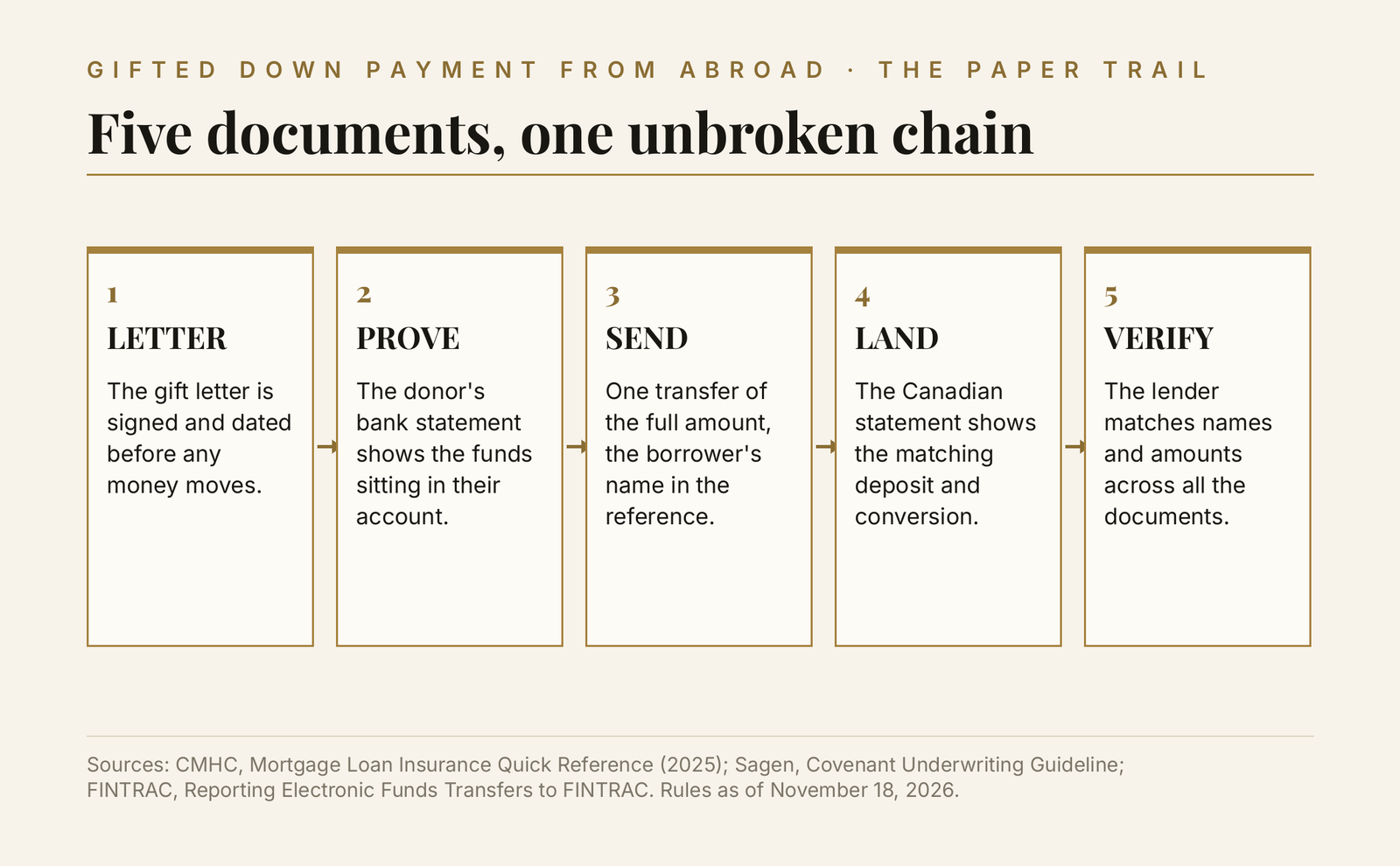
1. The signed gift letter, dated before the transfer. It states the donor’s name and relationship to you, the exact amount, the date, and that the gift is non-repayable. Most lenders and insurers have their own template. Sign it before the money moves, not in a scramble after the lender asks, because a letter dated after the transfer invites the question of what else was arranged after the fact.
2. The donor’s bank statement, showing the money was theirs. Sagen’s guideline puts it in one line: the source of funds must be verified in the donor’s or the borrower’s account. A statement showing the balance sitting in your parents’ account over time is that verification. A balance that appeared in full the week before the transfer, from nowhere visible, starts a second round of questions about where the gift itself came from. If your parents sold land, matured a fixed deposit, or sold gold to raise the gift, the sale record joins the file and closes that question before it opens.
3. The transfer record. One transfer of the full amount, sent through the banking system, with your name in the reference. The SWIFT confirmation or the bank’s transfer receipt is the document. One clean transfer is not just tidier than five small ones; it is easier to verify, and verification is the whole game.
4. Your Canadian bank statement, showing the money land. The deposit, the conversion, the amount in Canadian dollars. This is the link lenders check against documents 2 and 3: same sender, same receiver, amounts that reconcile after exchange and fees.
5. Your down payment history. Most lenders verify a down payment with up to 90 days of account statements. That is lender practice rather than a published CMHC rule, but plan for it: any large deposit inside that window, gift or otherwise, will be asked about, and the first four documents are the answer.
A worked example, from the shape of files I see in Calgary. A $520,000 purchase needs a minimum down payment of $27,000: 5 percent of the first $500,000, plus 10 percent of the remaining $20,000. The parents gift $40,000, which covers the full minimum down payment and leaves room toward a larger one. Letter signed first. Parents’ statement shows the balance in place.
One transfer, full amount, daughter’s name in the reference. It lands, converted, in her Calgary account, and the lender matches the four documents in one pass. Nothing about that file is exotic. It is simply a gift that arrived with its history attached. Where the gift
fits into the wider down payment math, including the FHSA and the Home Buyers’ Plan, is in my Calgary first-time buyer stack.
That same paper trail helped a first-time buyer approved on a work permit close on a $317,000 Calgary townhome with 5% down.
Four ways real gifts get rejected
Every one of these involves money that was genuinely given. The gift was real; the proof was not.
Routing through a third person. The money lands in an uncle’s account first, then moves to the parents, then to the buyer. Each hop breaks the chain the lender is trying to follow, and a chain with a stranger in the middle cannot be verified as a family gift. Send it directly from the donor to the buyer.
Cash and undocumented deposits. Money carried in person and deposited as cash, or deposited without the transfer record kept, has no link 3. The lender can see the deposit and nothing before it. That gap is the refusal.
A gift letter dated after the money moved. Backdating is worse than late dating, so do not do either. A late letter can sometimes be explained; a letter that claims a date it was not signed on is a credibility problem for the whole file.
A donor account with no history. The gift is the parents’ life savings, but it sat outside the banking system, so the account shows a single large deposit days before the transfer. The fix is upstream: money that will become a down payment gift should sit in the donor’s bank account, visibly, as early as possible. If an asset was sold to raise it, keep the sale documents with the statements.
The $10,000 question: what FINTRAC reporting actually means
Almost every family asks some version of this: will a transfer this large get reported, and is that a problem?
The honest answer is yes, it gets reported, and no, it is not a problem. Under FINTRAC’s rules, your bank must report an international electronic funds transfer of $10,000 or more to the Financial Transactions and Reports Analysis Centre of Canada. The duty belongs to the bank, not to you, the report is routine, and millions of ordinary transfers, tuition payments, family support, down payment gifts, are reported every year. It is not a tax, it does not hold your money, and it does not mark your mortgage file. Lenders see reported transfers constantly; what they care about is the document trail in the section above.
Two practical consequences. First, there is no benefit in splitting a gift into smaller transfers to stay under $10,000. FINTRAC’s rules add transfers together inside a 24-hour window, and beyond that, a pattern of split transfers is precisely what makes a bank look harder at money that a single clean transfer would have explained by itself. Second, because the transfer will be documented anyway, you may as well make it the most documented version: full amount, banking system, names matching the gift letter.
If the money already moved the messy way
Plenty of families send the money first and meet a mortgage broker second. Some of that can be rebuilt.
What can usually be rebuilt: a proper gift letter signed now and dated honestly, statements from both banks showing the money leaving the donor and arriving with the buyer, transfer receipts recovered from the sending bank, and sale records for whatever the parents sold to raise the gift. What cannot be rebuilt is a hop through a third person’s account with no records, or cash that entered the system with no origin story. In those cases the realistic options are time, letting the funds sit in your account while a new history builds, or restructuring the purchase around the portion of the down payment that can be proven.
This is a file-by-file conversation, and it goes better the earlier it happens, ideally before an offer is written. The general document habit that prevents most of this is in my mortgage application checklist.
Questions I get asked about this
Can my parents gift the entire down payment?
Yes. The full down payment can be a gift from immediate family, with the signed gift letter and the document trail above. You will still need your own funds for closing costs, and your income still has to qualify for the mortgage itself; the gift answers the down payment question, not the income question.
Is a gift from abroad taxed in Canada?
No. Canada has no gift tax, and a genuine gift is not taxable income to the person who receives it. What lenders and banks ask for is proof of where the money came from, which is a documentation question, not a tax bill.
How early should the money arrive in Canada?
Earlier than feels necessary. Have it in your Canadian account before the lender’s final verification, and ideally before you write an offer, so the full trail is sitting in your statements when the file is reviewed. A gift still in transit during the final week before closing is the most common avoidable delay I see on newcomer files.
Can a sibling or an uncle be the donor?
A sibling is on the insurers’ immediate family list, so yes. An uncle or aunt sits outside most insurers’ standard list, and a gift from outside the family circle is usually treated as borrowed money instead, which changes the product and, for work permit holders, may not be available at all. If the donor is anyone other than a parent, grandparent, sibling, child, or legal guardian, ask before the money moves, not after.
Family abroad is sending your down payment, or already has? Book a free call and we will map the paper trail on your actual file before an offer depends on it: https://cal.com/buildwithaky
This article provides general information. Mortgage options and eligibility depend on your circumstances and lender requirements. Speak with Aky about your situation.