
Yes. Getting a mortgage on maternity leave is possible, and files like this get approved every week. Leave does not end your employment, and lenders know that. What decides the file is not the leave itself. It is whether your income can be verified as continuing.
That verification comes down to one document: a letter from your employer confirming your job, your pay, and the date you go back. With that letter in place, many lenders will qualify you on your returning salary. Without it, the same file often gets read on your EI benefits alone, and EI is capped far below most salaries. Same job, same pay, two very different approvals. This post walks through how lenders read leave income, what that letter needs to say, and how to time a purchase around a leave.
In this post
- Why EI alone shrinks the file
- The letter that changes the file
- How lenders read leave income
- The stress test still applies
- Timing a purchase around a leave
- If the letter is weak or the return is far away
- Questions I get asked about this
Why EI alone shrinks the file
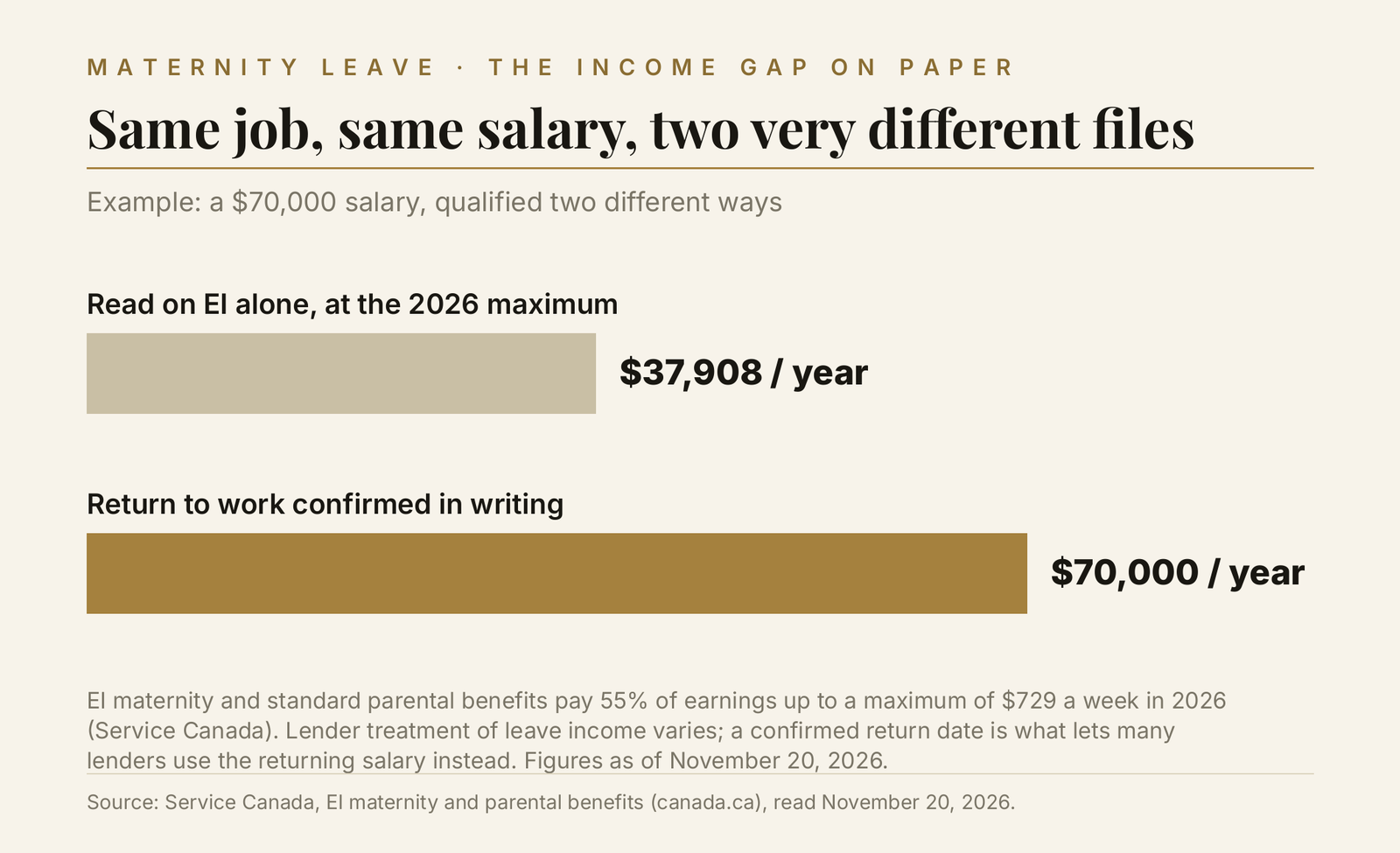
Start with the numbers, because they explain everything else. Service Canada pays EI maternity benefits and standard parental benefits at 55 percent of your earnings, up to a maximum of $729 a week in 2026. Extended parental benefits pay 33 percent, up to $437 a week.
Run that against a real salary. A buyer earning $70,000 who gets read on EI alone, even at the very maximum, shows $37,908 a year of income on the file ($729 times 52 weeks). Read on her confirmed returning salary, the same file shows $70,000. The gap between those two numbers is roughly the gap between a starter condo and the house the family actually wanted, and nothing about the buyer changed. Only the paperwork did.
This is also why a quick online calculator can mislead you during a leave. The calculator takes the income you type in. If you type the EI amount, you get the EI answer. The underwriter’s answer depends on what your employer is willing to confirm in writing.
The letter that changes the file
The employer letter is the centre of a leave file. The Financial Consumer Agency of Canada lists proof of employment among the core documents for a preapproval, and on a leave file the letter has to do more than confirm you work there. It helps that the law is on the letter’s side: in Alberta, after 90 days with the same employer, maternity and parental leave is job protected, your employer must give you your same or an equivalent job back, and you are considered continuously employed while you are off. The letter is simply putting that reality on letterhead. From the underwriting side, a letter that works confirms:
- Your position and that you are a permanent employee
- Your salary, or your hourly rate and your guaranteed hours
- That you are on an approved maternity or parental leave, and when it started
- Your return to work date
- That your position, pay, and hours on return are the same as before the leave
Two of those lines do the heavy lifting: the return date and the guaranteed hours. In file reviews I see the same pattern repeat. A letter that says an employee is “expected back sometime next year” comes back with a condition attached, because the underwriter cannot underwrite “sometime.” A letter with a specific date and confirmed hours goes through as income. If your hours are guaranteed rather than scheduled week to week, the letter needs to say that in those words.
Ask for this letter early. Human resources departments can take a week or two, and the request is easier before the leave starts than from home with a newborn. If you are already on leave, it is still a routine request. Employers write these letters constantly.
How lenders read leave income
There is no single published rule that every lender follows, and any page that promises you one is guessing. In practice, leave files get read three ways:
1. On the returning salary. Your employer confirms the job, the pay, and a return date the lender is comfortable with, and the file is qualified on your regular income. How far out that return date can be varies by lender and by insurer, which is one reason the same file can get different answers at different lenders.
2. On current income only. No letter, a return date too far out for that lender, or a return that is not guaranteed, and the file is read on EI and whatever other household income exists. This is the $37,908 version of the file above.
3. Somewhere between. Some lenders lean on the other applicant’s income, a co-borrower’s income, or a larger down payment to carry a file whose leave income they will not fully count.
Two details matter inside all three reads. First, the confirmed base salary or guaranteed hours are what carry. Overtime, bonuses, and commissions earned before the leave may be averaged over two years or set aside entirely, because the lender is underwriting what is guaranteed to return. Second, if you plan to go back part time, the honest number is the part-time income. A letter that confirms a full-time return you do not plan to make is a problem that surfaces at the worst possible time, usually right before funding.
The stress test still applies
A leave does not change the qualifying math itself. Per the Financial Consumer Agency of Canada, federally regulated lenders qualify you at the higher of 5.25 percent or your contract rate plus 2 percent. For an insured mortgage, CMHC’s general requirements keep total housing costs at or under 39 percent of gross household income (the GDS ratio) and total debts at or under 44 percent (the TDS ratio). CMHC also sets the minimum down payment at 5 percent on the first $500,000 of the price and 10 percent on the portion above that, and puts closing costs at roughly 1.5 to 4 percent of the purchase price.
What the leave changes is which income figure goes into those ratios. That is the whole game, and it is why the letter matters more than any single rate quote you will get this year.
Timing a purchase around a leave
If you know a leave is coming and a purchase is on the horizon, the cleanest order is:
- Get the preapproval done before the leave starts, while your pay stubs show your regular income. The Financial Consumer Agency of Canada is clear that a preapproval is not a guarantee, but a reviewed file with documents in place is a much stronger starting point than a rate hold built on a phone call.
- Ask for the employer letter before you go off, or in the first weeks of the leave, while the return date is easy for your employer to confirm.
- Keep the down payment boring. Three months of clean statements, no unexplained large deposits, gifts documented the way lenders ask. Leave files get enough questions without adding money-trail ones. If family is helping with the down payment, the paper trail matters as much as the money, and I covered it in my post on gifted down payments from abroad.
- Do not change jobs mid-file. A new employer on return resets the income story. If a change is genuinely planned, raise it before you write an offer, not after.
- Plan the leave months in cash, not just on paper. Qualifying on your returning salary does not change what actually lands in your account while you are off. The families who enjoy the new house are the ones who budgeted the leave itself.
Buying for the first time and planning around a baby in the same year? The account deadlines still run. FHSA contribution room is worth eight thousand dollars of room a year, and it does not pause for parental leave, so the account belongs on the same calendar as the baby.
If the letter is weak or the return is far away
A weak letter is a routing problem more often than it is a dead end. The practical moves, in order:
- Fix the letter first. Most weak letters are just incomplete. A revised letter with the return date and guaranteed hours added solves the file without changing lenders.
- Route the file to a lender whose leave policy fits your dates. Return-date windows differ. A file that is early for one lender can be standard for another.
- Carry the file on the household. A partner’s income, a co-borrower, or a guarantor can hold the ratios while your income is read conservatively. Support income, if it is part of your household picture, has its own paper trail, covered in my post on using support income for a mortgage.
- Adjust the target, not the dream. A smaller first purchase that closes cleanly beats a firm offer written on income nobody has confirmed.
Questions I get asked about this
Can I apply while I am pregnant, before the leave starts?
Yes, and it is usually the cleanest time to do it. Your current pay stubs show your regular income, and your employer can confirm the upcoming leave and your return date in the same letter.
Does my partner’s income count if I am the one on leave?
Yes. Lenders qualify the household together, so your partner’s income goes into the same GDS and TDS ratios. Your leave income treatment decides how much of your income joins it.
What if I am self-employed and taking a leave?
Different file entirely. Self-employed income is usually read from your last two years of tax filings, and EI special benefits for self-employed people only exist if you registered and paid in ahead of time. The two-year history does the talking, so a planned leave year matters less than your filed history, but the cash planning matters more. My post on self-employed mortgage planning walks through how that income story gets built.
What if my return date changes after I am approved?
Tell your broker as soon as you know. A small shift is usually a conversation. A return that disappears, or turns into a different job at different pay, is a material change the lender has to hear about before funding, not after.
Buying around a leave? Start with the letter
If a baby and a home purchase are landing in the same year, the highest-value first step is not a rate quote. It is a preapproval built on your real documents, with the employer letter requested early enough to matter. Book a call at https://cal.com/buildwithaky and we will map your dates, your leave, and your price range in one conversation.
Aky Abrol, Mortgage Expert, Artisan Mortgages, Calgary. Licence #00678952. 403-473-0026.
This article provides general information. Mortgage options and eligibility depend on your circumstances and lender requirements. Speak with Aky about your situation.