By Aky Abrol, Mortgage Expert, Artisan Mortgages, Calgary (Alberta licence #00678952)
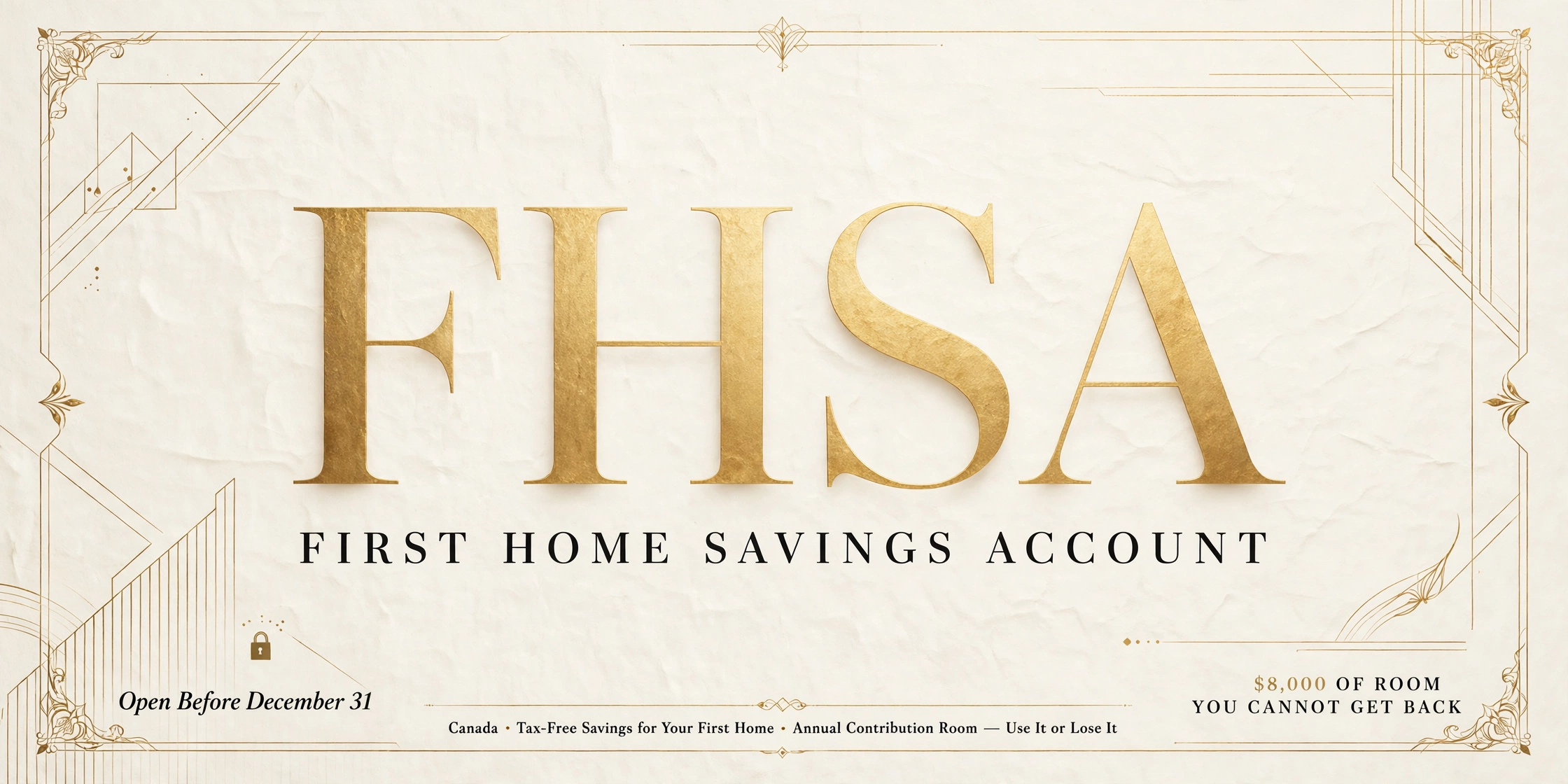
If you plan to buy your first home in the next few years and you have not opened a First Home Savings Account yet, open one before December 31, even if you cannot put a dollar in it this year. FHSA contribution room does not exist until the account does. The Canada Revenue Agency gives you $8,000 of participation room for the year you open your first FHSA, and nothing for any year before that, ever. An account opened in December 2026 starts your clock in 2026. The same account opened in January 2027 starts it in 2027, and the 2026 room is not delayed or reduced. It is simply never created.
This is the one deadline in the first-time buyer programs that cannot be repaired after the fact. Every spring I meet buyers who did everything else right, saved the money, kept their credit clean, and then discover at the pre-approval table that a year of FHSA room is missing because nobody told them the account itself was the deadline. The fix takes minutes in December. In February there is no fix.
In this post:
- Why December 31 is the real FHSA deadline
- How FHSA contribution room actually builds
- Who can open one
- Already opened yours? What to check before year end
- How this fits the rest of the down payment
- Questions I get asked about this
Why December 31 is the real FHSA deadline
Most registered accounts forgive a late start. The TFSA builds room from the year you turn 18 whether you open one or not. RRSP room follows your earned income. The FHSA works the other way: the CRA’s rule is that your participation room in the year you open your first FHSA is $8,000, and your carryforward in that first year is $0. There is no mechanism anywhere in the program that creates room for a year when no account existed.
The CRA’s own worked example shows what that means in practice. A buyer who opened her first FHSA in June 2026 and contributed nothing at all that year filed her taxes, and her notice of assessment showed $16,000 of participation room for 2027: her unused 2026 room carried forward and stacked on top of 2027’s. Had she waited and opened the identical account in January 2027, her 2027 room would be $8,000. Same saver, same income, same $0 contributed. The only difference is which side of December 31 the account was opened on, and it is worth $8,000 of room.
Two related traps sit next to this one. First, there is no RRSP-style grace window: FHSA contributions belong to the calendar year they are made in, January 1 to December 31, so a contribution in January 2027 is a 2027 contribution and cannot be pulled back into 2026. Second, contributing and opening are different acts with different deadlines. Money can go in whenever you have it, this year or a later one, within your room. The account has to exist before the year turns. If cash is tight in December, that is fine. Open the account, fund it when you can.
How FHSA contribution room actually builds
Three numbers run the whole program, all from the Canada Revenue Agency’s FHSA pages, as of November 19, 2026.
$8,000 a year. That is your participation room for the year you open the account and for each year after. It is one pool per person, not per account: contributions to multiple FHSAs and transfers in from your RRSP all draw on the same $8,000, and growth inside the account does not touch your room at all.
Up to $8,000 carries forward. Room you do not use moves to the next year, but the carryforward is capped at $8,000. That cap is the most misunderstood rule in the program. It means the most room you can ever hold in a single year is $16,000, and it means skipping three years does not bank three years of catch-up. Unused room beyond the cap does not vanish from your $40,000 lifetime limit; it just cannot be used faster than the cap allows, so a late or stop-start saver takes longer to get there.
$40,000 over your lifetime. Contributions and RRSP transfers combined stop at $40,000 per person.
Put the three together and the December decision prices itself:
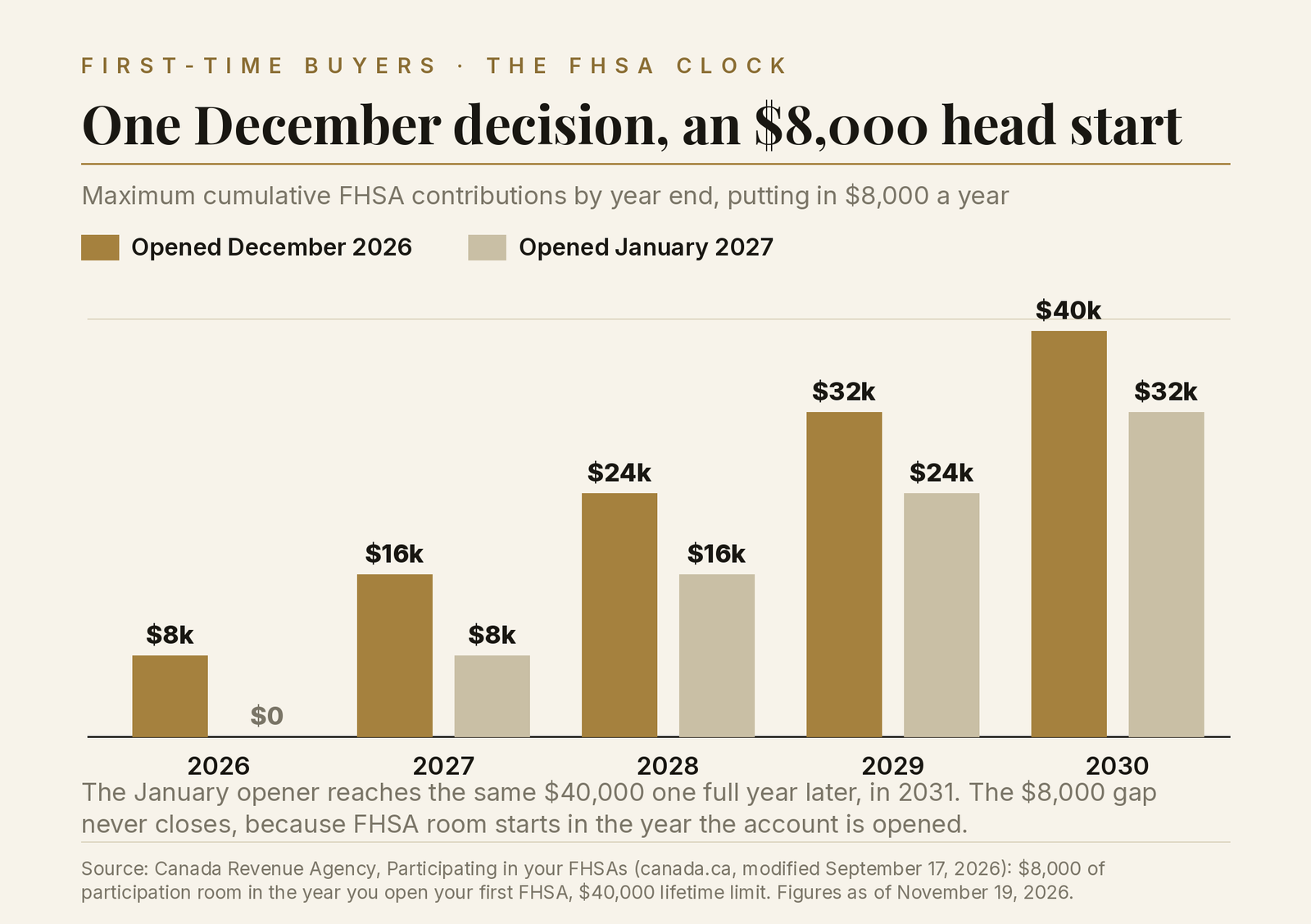
Both savers put in the same $8,000 a year once they start. The December opener finishes the full $40,000 at the end of 2030; the January opener finishes at the end of 2031, a full year later, and runs exactly $8,000 behind at every step in between. Nothing either of them does later closes that gap, because the gap is not about savings discipline. It is about which calendar year the clock started in.
One multiplier worth stating plainly, because couples miss it constantly: the room is per person. Two partners who each qualify can each open an FHSA, each build their own $40,000, and put up to $80,000 of contributions toward the same home. One shared savings plan with one account leaves the second $40,000 unstarted, and its clock is also ticking toward its own December 31.
Who can open one
The CRA calls an eligible opener a qualifying individual, and the test is applied at the moment you open the account, on the Opening your FHSAs page:
You are a resident of Canada and at least 18 years old.
You are a first-time home buyer under the look-back test. At the time you open, you have not, at any time in the current calendar year or the previous four calendar years, lived in a home as your principal place of residence that you owned, or that your spouse or common-law partner owned. The partner half of that sentence is the one that surprises people: living in a home your partner owns can disqualify you even if you have never owned anything yourself. If you owned and sold a home five or more years ago, you may qualify again, which makes this worth checking rather than assuming.
Opening itself is simple. Accounts are offered by issuers: banks, credit unions, and trust or insurance companies. You provide your social insurance number and date of birth, and the issuer registers the account. Then one piece of homework that catches people out: you file Schedule 15 with your tax return for the year you open your first FHSA, even if you contributed nothing. That filing is how the CRA learns the account exists, and it is what makes your participation room show up on your notice of assessment and in your CRA account the following year.
Already opened yours? What to check before year end
If your FHSA is already open, your clock is running and December 31 is less dangerous, but three checks are still worth ten minutes.
Find your actual room. Your participation room statement sits in your CRA account under Savings and pension plans, and on your latest notice of assessment. If you opened in a prior year and contributed nothing, expect to see the carried-forward room waiting; if the number looks wrong, unfiled tax returns are the usual reason, because the CRA builds the statement from assessed returns.
Decide on this year’s contribution separately from the deduction. A contribution made by December 31 counts in 2026. The deduction does not have to be claimed in 2026: amounts you do not deduct carry forward, so a buyer whose income jumps next year can contribute now and claim in the higher-income year. Contribute for the room and the tax-free growth; deduct on the schedule that pays you more.
Do not overshoot. Contributions and RRSP transfers above your room create an excess FHSA amount, taxed at 1 percent per month on the highest excess in the month until it is removed. The transfer trap is the common one: moving $8,000 from an RRSP and then contributing $8,000 of cash in the same year is $16,000 into $8,000 of room. Check the statement first, then move money.
How this fits the rest of the down payment
The FHSA is one layer of the down payment, not the whole plan. It pairs with the RRSP Home Buyers’ Plan, which allows up to $60,000 per person toward the same home, and the two can be used together on one purchase: up to $40,000 of FHSA plus up to $60,000 of HBP per buyer, with the FHSA side carrying the better tax treatment because a qualifying FHSA withdrawal is never repaid.
How the layers stack in order, alongside the other first-time buyer programs, is in my Calgary first-time buyer stack. The wider plan around it, timelines, costs, and what to prepare before you shop, is in my practical guide to buying your first home in Canada, and the document habits that keep a purchase smooth are in my mortgage application checklist. The FHSA’s contribution to all of it is decided years earlier, at a bank counter, in about ten minutes. That is the whole argument for doing it this month.
Questions I get asked about this
I opened my FHSA in 2023 and never contributed. How much room do I have?
More than you fear, less than you might hope. Your room has been building since 2023, but because the carryforward caps at $8,000, the most you can put in during any single year is $16,000, and your $40,000 lifetime limit is intact. Your exact figure is printed on your CRA participation room statement. The good news inside that answer: your clock started in 2023, which puts you years ahead of someone opening today.
Do I have to contribute by December 31 too, or just open the account?
Opening is what starts the clock, so opening is the December emergency. Contributions for the 2026 tax year also have to land by December 31, 2026, because there is no January catch-up window, but if you cannot fund it this year, up to $8,000 of the room carries into 2027. Open now, fund when you can, and nothing is lost except the option to backdate, which never existed.
Can my partner and I each open one?
Yes, if you each pass the qualifying test on your own facts, including the look-back at homes either of you owned and lived in. Each account is individual: only the holder contributes to their own FHSA and claims their own deduction. Together you can build up to $80,000 of FHSA contributions toward one home.
What happens if I never buy a home?
The account cannot run forever. Your maximum participation period ends on December 31 of the earliest of three dates: the 15th anniversary of opening your first FHSA, the year you turn 71, or the year after your first qualifying withdrawal. If you reach the end without buying, the money is not stranded: amounts in the FHSA can be transferred to your RRSP on a tax-free basis, without using any of your RRSP room. Opening early costs you nothing if plans change; opening late costs room you cannot recover if they do not.
Buying your first home in 2027 or 2028 and not sure whether your FHSA clock is running? Book a free call and we will check your room against your purchase timeline before December 31 closes the 2026 year: https://cal.com/buildwithaky
This article provides general information. Mortgage options and eligibility depend on your circumstances and lender requirements. Speak with Aky about your situation.