
Yes, you can find out whether you can afford to keep the house before you sign anything, and that is exactly when the question has to be answered. Keeping the house is not decided by how much equity is in it. It is decided by four numbers and one income test, and all of them can be run on draft figures while the separation agreement is still being negotiated. Once the agreement is signed, the numbers inside it become the numbers a lender underwrites to. If they do not work, the fix is no longer a conversation. It is an amendment, with lawyers on both sides.
Most couples do this in the wrong order. They settle the house first, because it feels like the biggest question, and test the mortgage later, because it feels like paperwork. The mortgage is not paperwork. It is the part that decides whether the settlement can actually happen.
Table of Contents
Why the signature changes everything
A lender does not underwrite your intentions. It underwrites your documents. The insured spousal buyout program, the route that lets one spouse borrow up to 95 percent of the home’s value to buy out the other, requires a finalized separation agreement or a court order on file, and the buyout amount in that document sets what can be borrowed. The mechanics of the buyout itself are covered in my buyout guide. The point here is what the signature does to your options.
Support is where the signature bites hardest. Child or spousal support you receive counts as qualifying income only once it is written into a signed agreement or court order and you can show it arriving. Support you pay lands in your total debt service ratio in full. I walk through the support income rules in detail in a separate post. What matters for timing is this: the same support dollars change your application the moment they are on paper, in either direction. Negotiating a support figure without knowing which side of your ratios it lands on is how people sign themselves out of a house they could have kept, or into one they cannot carry.
The four numbers that decide it
1. What the home is actually worth. Not the tax assessment, and not what a similar home on the street listed for. The buyout runs off an appraised value, and every number below is built on it. An independent appraisal early in the process removes the most common fight before it starts.
2. The net equity, calculated the Alberta way. In Alberta, property division runs under the Family Property Act, which presumes an equal division of what was acquired during the relationship, for married spouses and adult interdependent partners alike. The negotiation math prices the house as if it were sold: value, minus the mortgage, minus the costs a sale would have carried. That last deduction is the one couples forget. Equity on paper is not equity in the settlement.
3. The buyout amount. The new mortgage has to retire the old one and pay the departing spouse their share. Because the buyout is treated as a purchase rather than a refinance, it can reach 95 percent of the value instead of stopping at the usual 80 percent refinance ceiling. On most Calgary files, that ceiling is not what stops the deal.
4. Your ratios at the stress test rate. This is what stops the deal. You qualify alone, at the greater of your contract rate plus 2 percent or 5.25 percent, the federal stress test the Financial Consumer Agency of Canada sets out in its qualifier tool. Your housing costs need to sit under 39 percent of your gross income (the GDS ratio), and housing plus every other debt payment, including support you pay, under 44 percent (the TDS ratio). Two incomes carried the house in. One income, tested at a rate roughly 2 points above the real one, has to carry a bigger mortgage out.
The worked example
A Calgary home appraised at $650,000, owned 50/50, with $470,000 owing. If the home sold, the commission on the common Alberta structure (7 percent of the first $100,000 and 3 percent of the balance), plus GST on the commission and legal fees, would run about $26,500. That puts the net equity at $153,500, and the departing spouse’s half at $76,750. The new buyout mortgage is $470,000 plus $76,750: $546,750, which is 84.1 percent of the value.
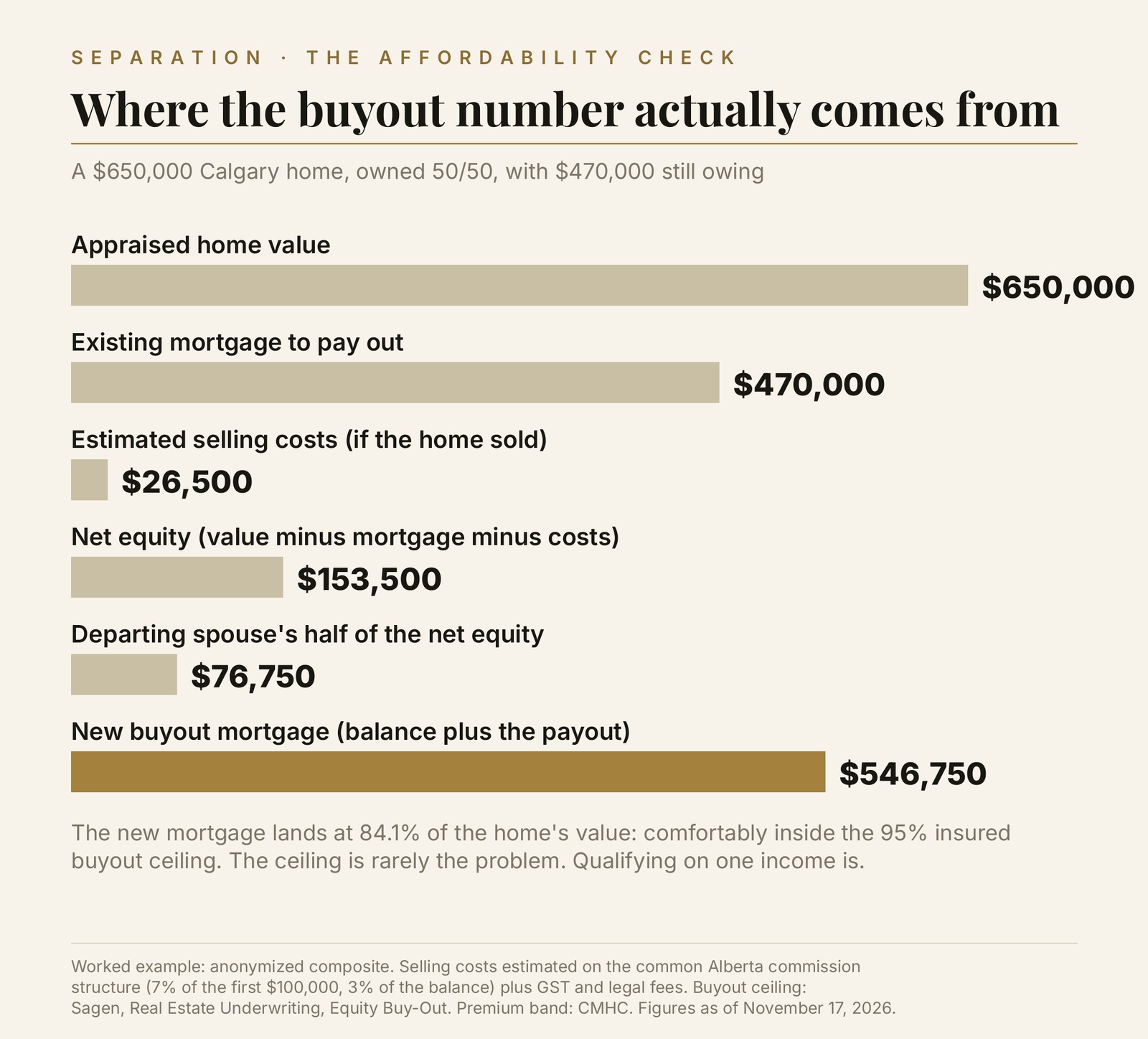
At 84.1 percent loan-to-value, the mortgage insurance premium is 2.80 percent of the loan on CMHC’s published schedule, $15,309, added to the mortgage for a total of $562,059. One Alberta advantage: CMHC lists only Quebec, Ontario and Saskatchewan as charging provincial sales tax on that premium, so there is no tax bill on it here.
Now the income test. The spouse keeping the house earns $112,000 a year. Using a 3.70 percent variable rate (the rate I advertise as of November 17, 2026), the stress test qualifying rate is 5.70 percent, and the payment used for qualifying is $3,519 a month on the $562,059 mortgage over 25 years. Add $325 for property tax and $150 for heat, and housing costs are $3,994 a month.
- Without support counted: $3,994 against a 39 percent GDS ceiling of $3,640. The ratio is 42.8 percent. The file does not qualify.
- With the signed agreement’s child support counted: the agreement sets child support at $850 a month. Child support is not taxable, and the insurers gross non-taxable income up, 25 percent at this level, so it counts as $1,063 a month. Income becomes $10,396 a month, the GDS ratio drops to 38.4 percent, and the file qualifies. Even with a $420 car payment added, the TDS ratio is 42.5 percent, inside the 44 percent ceiling.
Same house, same job, same debts. The only difference is whether the support line exists on paper, and what it says. Run the mirror image and it gets sharper: if this spouse were paying the $850 instead of receiving it, that payment would sit in the TDS ratio in full and push it to about 56 percent. The house is gone at that number. That is the negotiation your support figure deserves, before it is signed, not after.
The order that works
- Value the home. Appraisal or a defensible market valuation both sides accept.
- Calculate the net equity. Value, minus mortgage, minus selling costs. This is the number being divided.
- Run the affordability test on draft figures. Your income, the draft support numbers running in the direction they will actually run, your real debts, at the stress test rate.
- Then let the lawyers draft. An agreement written around numbers that already qualify is an agreement that closes.
Steps 1 to 3 cost a conversation. Skipping them can cost an amended agreement, a second round of legal fees, and a house you had already mentally moved back into.
If the numbers do not work
Sometimes the honest answer is that one income cannot carry the house, and finding that out early is still worth money. The options that remain are real ones:
- Rebalance the split. The departing spouse can take a larger share of other assets, an RRSP or pension share instead of house equity, which lowers the buyout amount and the mortgage with it. The division stays equal; its shape changes.
- Sell and split the proceeds. Nobody’s preference, and not starting from zero either. The Home Buyers’ Plan has a specific exception for the breakdown of a marriage or common-law partnership (Income Tax Act s.146.01(2.1)): after living separate and apart for at least 90 days because of the breakdown, a spouse buying a home of their own can withdraw up to $60,000 from their RRSP under the plan even if they owned the home they just left.
- Wait, deliberately. A short period where both names stay on the mortgage while incomes, debts or support arrangements settle is sometimes the right bridge. It carries real risk, because both of you remain liable for the debt, so it belongs in the agreement with an end date, not in a handshake.
What does not help is signing first and hoping the mortgage works out. Hope is not an underwriting category.
Questions I get asked about this
Can I run the affordability check before the separation agreement is signed?
Yes, and that is the right time for it. The check runs on draft figures: the expected value, the expected split, the support numbers being negotiated. Final mortgage approval needs the signed agreement or a court order on file, but nothing about the test itself has to wait for signatures.
Does child support count as income before anything is signed?
No. Insurers want it in a signed separation agreement or a court order, with a record of it actually being received. A verbal arrangement, however reliable it feels, is not income a lender can use. The detailed rules, including the gross up for non-taxable support and the referral threshold when support is more than half of your income, are in my support income guide.
Can I just take over the existing mortgage instead of getting a new one?
Taking over the existing mortgage keeps the old balance. It cannot pay your spouse their share of the equity, and until a lender formally releases them, your spouse stays liable for the debt. Paying out equity takes new financing, which is what the spousal buyout is built for.
What if we cannot agree on what the home is worth?
Then the appraisal decides it. The buyout program runs off an appraised value ordered for the file, and getting an independent appraisal early takes the single most argued number off the table while the rest of the agreement is negotiated.
Separating, and the house is the open question? Book a free call and we will run your four numbers on your actual figures, before anything is signed: https://cal.com/buildwithaky
This article provides general information. Mortgage options and eligibility depend on your circumstances and lender requirements. Speak with Aky about your situation.