
By Aky Abrol, Mortgage Expert, Artisan Mortgages, Calgary
The short answer
Yes. A new to Canada mortgage can be insured without a Canadian credit history. Under CMHC’s Newcomers program, lenders can establish your creditworthiness using an international credit report, a reference letter from your bank in your home country, or 12 months of documented payments such as rent plus one other regular obligation (CMHC Newcomers fact sheet, accessed November 7, 2026).
Permanent residents and work permit holders are both eligible. The minimum down payment follows the same federal rules as for any other buyer, and there is no minimum period you must have lived in Canada before you apply.
Having no credit history is a documentation problem. It is not a disqualification. The rest of this post walks through exactly which documents replace a credit score, what it costs, and a worked example on a Calgary priced home.
Table of Contents
Who counts as a newcomer for a mortgage
CMHC’s Newcomers program covers two groups:
- Permanent residents, including landed immigrants and people who arrive with permanent residency already granted.
- Non-permanent residents who are legally authorized to work in Canada, which in practice means a valid work permit.
Both groups can access insured financing with less than 20 percent down. There is no minimum residency period in the CMHC program, so a family that landed three months ago is not told to wait a year before applying. What the lender still needs to verify is your status, your income in Canada, and your down payment. Those three items decide the file, not the age of your Canadian credit file.
4 ways to qualify for a newcomer mortgage in Canada without a credit score
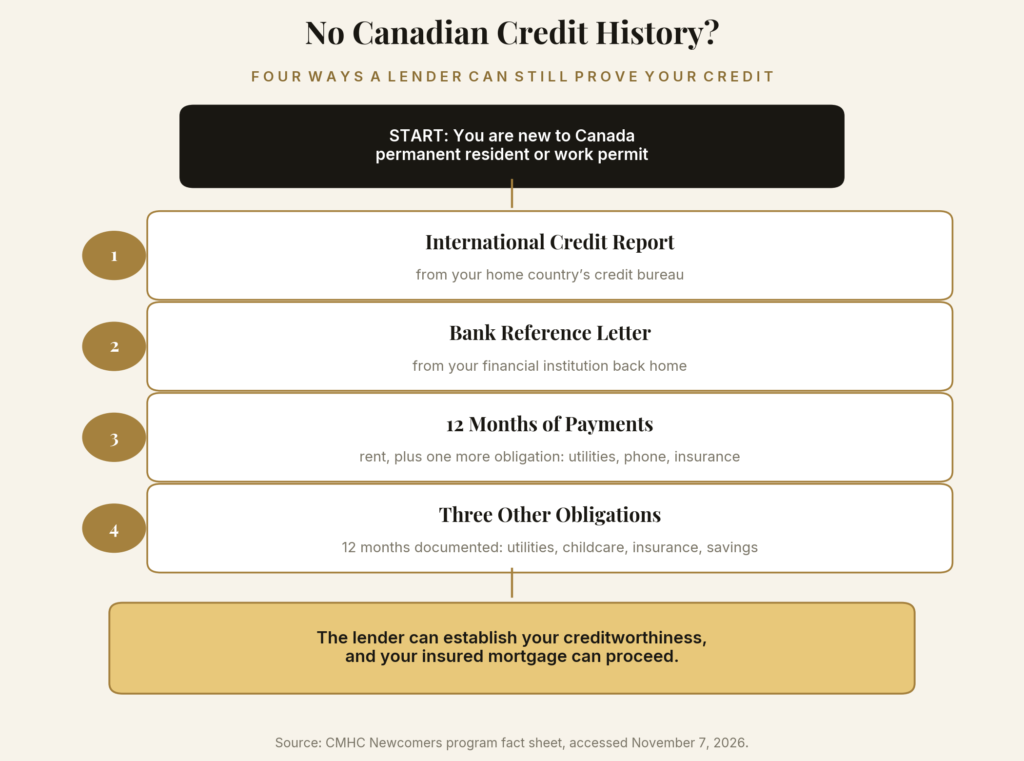
CMHC sets a minimum credit score of 600 for at least one borrower or guarantor where a Canadian credit report exists. Where it does not, CMHC lets the lender establish creditworthiness in other ways (CMHC Newcomers fact sheet, accessed November 7, 2026):
- An international credit report from your home country’s credit bureau.
- A letter of reference from your financial institution in your country of origin, confirming your accounts, any loan repayments, and your standing with that bank.
- Alternative payment history covering the preceding 12 months: confirmation of rent or room and board payments, plus one additional financial obligation, such as a utility bill, a phone bill, insurance premiums, or documented regular savings.
- If rent confirmation is not available, three other types of obligations documented over the preceding 12 months, such as utilities, cable, childcare expenses, insurance premiums, or regular savings.
Read that list carefully, because it tells you what to start collecting today. Twelve months of rent paid on time, proven with bank statements or e-transfer records and a landlord reference, is real credit evidence in this program. Twelve months of utility and phone bills in your name adds to it. An international credit report, if your home country has a bureau that issues one, is the closest substitute for the real thing.
One warning from files I see in Calgary: no Canadian credit and damaged Canadian credit are treated very differently. No history is expected of a newcomer, and the program above is built for it. A low Canadian score from a missed card payment in your first months here is a harder problem, because the 600 minimum then applies to a score that exists. Protect your first Canadian credit card like it matters, because it does.
Buying on a work permit: the foreign buyer ban comes first
Before any financing question, a work permit holder has to clear a legal one. The federal Prohibition on the Purchase of Residential Property by Non-Canadians Act currently runs until January 1, 2027, and it bans most non-Canadians from buying homes in Canadian cities, Calgary included (Prohibition on the Purchase of Residential Property by Non-Canadians Act and Regulations, current to October 2026).
Work permit holders have an exemption. You can buy if both of these are true on the date of purchase:
- You hold a work permit, or are authorized to work in Canada, with 183 days or more of validity remaining.
- You have not purchased more than one residential property.
Permanent residents are not affected by the ban at all. If you are on a work permit, check your remaining validity before you write an offer, not after. If your permit has 120 days left, the exemption is not available to you today, and timing your renewal matters more than timing the market.
How much down payment you need
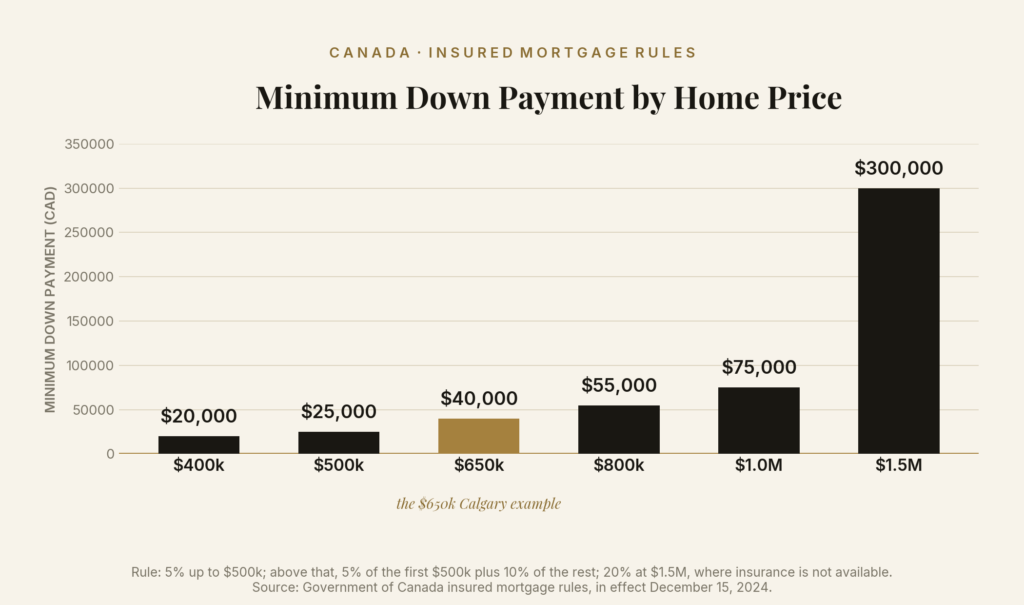
Newcomers follow the same federal minimum down payment rules as every other buyer in Canada (Government of Canada insured mortgage rules, in effect since December 15, 2024):
- Homes priced at $500,000 or less: 5 percent of the price.
- Homes priced above $500,000 and below $1,500,000: 5 percent of the first $500,000, plus 10 percent of the portion above $500,000.
- Homes priced at $1,500,000 or more: 20 percent, because mortgage insurance is not available at that price. The insured price cap rose from $1 million to $1.5 million on December 15, 2024.
Two newcomer specific points sit on top of those rules.
First, if your down payment is under 20 percent, the mortgage must be insured by CMHC, Sagen, or Canada Guaranty, and you pay the insurance premium.
Second, if you are a non-permanent resident, CMHC does not allow non-traditional down payment sources at the highest loan to value range. Borrowed down payment money is off the table on a work permit file (CMHC Newcomers fact sheet, accessed November 7, 2026).
Your down payment should be your own saved funds. Your lender will ask for a paper trail: bank statements showing the money accumulating, and the transfer records if the funds came from abroad. Move the money early and keep every receipt.
If the money is a gift from family abroad, its paper trail is a separate job with its own five documents. I walk through them in order here: gifted down payment from abroad, the paper trail that gets it approved.
A gift from an immediate family member, confirmed with a signed gift letter, is a standard source for permanent residents. On a work permit the treatment is tighter and varies by lender, so confirm before any money moves, not after.
What the insurance premium costs
Mortgage default insurance protects the lender, and the premium is added to your mortgage rather than paid in cash at closing. CMHC’s standard premium schedule for an owner occupied home is set by loan to value (CMHC premium schedule, accessed November 7, 2026):
- 80.01 to 85 percent loan to value: 2.80 percent of the mortgage amount
- 85.01 to 90 percent loan to value: 3.10 percent
- 90.01 to 95 percent loan to value: 4.00 percent
- Choosing a 30 year amortization adds 0.20 percentage points to the premium
Alberta buyers get one small break here: Alberta charges no provincial sales tax on the insurance premium. Buyers in Ontario, Quebec, and Saskatchewan pay tax on top of the premium amount. In Alberta, the premium is the whole cost.
A worked example: a $650,000 home in Calgary
Take a newcomer family buying a $650,000 home in Calgary with the minimum down payment, insured through CMHC, at an example rate of 3.75 percent on a 5 year variable mortgage (rate shown for illustration, as of November 7, 2026; your rate is set when your application is approved).
The down payment. Five percent of the first $500,000 is $25,000. Ten percent of the remaining $150,000 is $15,000. Minimum down payment: $40,000, which is 6.15 percent of the price.
The mortgage. $650,000 minus $40,000 leaves a mortgage of $610,000, at 93.85 percent loan to value. That sits in the 90.01 to 95 percent band, so the CMHC premium is 4.00 percent: $24,400, added to the mortgage. Total mortgage: $634,400.
The payment, 25 year amortization: about $3,252 per month.
The payment, 30 year amortization: since December 15, 2024, first-time homebuyers can take an insured mortgage over 30 years. A newcomer buying a first home in Canada will often fit the federal first-time buyer definition (Government of Canada, December 2024 insured mortgage reforms). Once you qualify, the same programs stack the same way for any first-time buyer here: see the Calgary first-time buyer stack.
The premium rises to 4.20 percent, or $25,620, for a total mortgage of $635,620. The payment falls to about $2,933 per month, roughly $319 a month of breathing room.
The trade off is real. Held to the end of the amortization, the 30 year version costs roughly $79,000 more in interest. Lower payment now, higher total cost later. Neither is automatically right; it depends on how tight the monthly budget is in your first years here.
The stress test. You do not qualify at 3.75 percent. Every insured mortgage is qualified at the federal minimum qualifying rate: your contract rate plus 2 percentage points, or 5.25 percent, whichever is higher (Government of Canada minimum qualifying rate).
At 5.75 percent, the qualifying payment on this mortgage is about $3,965 a month. Add estimated property taxes of about $325 a month and heating of about $100 a month, and housing costs come to about $4,390 a month.
CMHC’s maximum gross debt service ratio is 39 percent (CMHC underwriting guidelines). This purchase therefore needs a household income of roughly $135,000 a year to qualify.
This is the number most newcomer families are missing when they start shopping. The home you can carry at the contract rate and the home you qualify for at the stress test rate are two different homes.
Your document checklist
Gather these before you apply, and the file moves faster:
- Passport and status documents: PR card or Confirmation of Permanent Residence, or your work permit
- Employment letter from your Canadian employer confirming position, start date, and salary, plus a recent pay stub. Insurer newcomer programs commonly ask to see at least three months of full-time Canadian employment, and your lender will confirm the current requirement on your file (Sagen New to Canada program summary, accessed November 7, 2026).
- Twelve months of rent payment records, plus one more obligation such as utilities or a phone bill, or an international credit report, or a reference letter from your home country bank
- Bank statements showing your down payment and its source, including transfer records for funds sent from abroad
- Your most recent tax return or Notice of Assessment if you have filed in Canada
Our full mortgage application checklist walks through each of these in more detail, and our first home buyer guide covers the buying process step by step once your financing is in place.
Start your Canadian credit file now, even if you buy this year
The alternative credit route gets you into a home. It does not build your Canadian score, and your score is what your next mortgage, renewal, and car loan will be priced on. Open a Canadian bank account and a first credit card as soon as you arrive, use the card lightly, and pay it in full every month. Twelve months of clean Canadian history puts you back in the standard system, where approvals are faster and cheaper to place.
Common questions
How long do I need to live in Canada before I can buy?
There is no minimum residency period under CMHC’s Newcomers program. You need valid status, verifiable Canadian income, a documented down payment, and credit evidence of one of the kinds listed above.
Can I buy with 5 percent down on a work permit?
Yes, subject to lender and insurer approval, provided you meet the work permit exemption under the foreign buyer legislation: 183 days or more remaining on your permit and no more than one residential property purchased.
Does money from my family abroad count as a down payment?
It can, with a full paper trail. Funds have to be shown moving from the source account into yours, and gifted funds need a signed gift letter confirming the money does not have to be repaid. Borrowed down payment funds are not accepted for non-permanent residents at the highest loan to value range.
Should I wait until I have a Canadian credit score?
Usually not, if the rest of your file is ready. The program exists because your payment history at home and your rent record here are meaningful evidence. Waiting a year to build a score while rents rise is a trade off worth running the numbers on, not an automatic rule.
Talk to a broker before you shop
Newcomer files fail on paperwork, not on people. The families who get approved cleanly are the ones whose documents were assembled before the offer went in. If you are new to Canada and buying in Calgary, book a call and we will map your status, your down payment, and your credit evidence against the current insurer rules before you fall for a house: https://cal.com/buildwithaky
When it comes time to renew or refinance, the same discipline applies; our renewal review guide shows what to check before you sign anything your bank sends you.
By Aky Abrol, Mortgage Expert, Artisan Mortgages, Calgary, Alberta. Licence 00678952.
Education only, not personal financial advice. Mortgage rules, insurer programs, and rates change, and eligibility depends on your full application. Confirm your own situation before you buy. This post was last fact checked on November 7, 2026.
Sources used in this post
- CMHC Newcomers mortgage loan insurance fact sheet, Canada Mortgage and Housing Corporation, accessed November 7, 2026: eligibility for permanent and non-permanent residents, minimum credit score of 600, alternative methods of establishing creditworthiness, non-traditional down payment restrictions for non-permanent residents, GDS 39 percent and TDS 44 percent thresholds.
- Government of Canada insured mortgage rules, in effect December 15, 2024: minimum down payment tiers, insured price cap of $1.5 million, 30 year amortization for first-time homebuyers and newly built homes.
- CMHC mortgage loan insurance premium schedule, accessed November 7, 2026: 2.80 percent, 3.10 percent, and 4.00 percent premium bands, plus the 0.20 percentage point surcharge for amortizations over 25 years.
- Prohibition on the Purchase of Residential Property by Non-Canadians Act and Regulations (Justice Laws Website, current to October 19, 2026): ban in force until January 1, 2027, work permit exemption requiring 183 days or more of remaining validity and no more than one residential property purchased.
- Government of Canada minimum qualifying rate: the greater of the contract rate plus 2 percentage points or 5.25 percent.
- Sagen New to Canada program summary, accessed November 7, 2026: three months of full-time employment guideline.
This article provides general information. Mortgage options and eligibility depend on your circumstances and lender requirements. Speak with Aky about your situation.