
By Aky Abrol, Mortgage Expert, Artisan Mortgages, Calgary
Yes. Child support and spousal support you receive can count as qualifying income for a mortgage in Canada. Canada Guaranty and Sagen, two of the three national mortgage insurers, both allow it in their published underwriting guidelines. What decides your file is not the support itself. It is whether you can document it: a court order or separation agreement that sets the amount, and a record showing the payments actually arrive as agreed.
Here is how lenders and insurers look at support income, where files get stuck, and what to gather before you apply.
What counts as support income
Both Canada Guaranty and Sagen treat child support and spousal support the same way in their support income rules. The income should be expected to continue based on the details in your court order, separation agreement, or divorce agreement. There is no separate, stricter test for child support in either insurer’s published guidelines.
Where child support and spousal support genuinely differ is tax, and tax matters for qualifying:
- Periodic spousal support is taxable income to the person who receives it, and deductible for the person who pays it (Canada Revenue Agency, Income Tax Folio S1-F3-C3: https://www.canada.ca/en/revenue-agency/services/tax/technical-information/income-tax/income-tax-folios-index/series-1-individuals/folio-3-family-unit-issues/income-tax-folio-s1-f3-c3-support-payments.html).
- Child support under a court order or written agreement made after April 1997 is not taxable to the recipient and not deductible for the payor (same CRA folio).
That tax difference feeds directly into how much income a lender can credit you with, which brings us to the gross up below.
The paper trail lenders actually ask for
Canada Guaranty (Underwriting Guidelines, March 2026, section 3.3.3) and Sagen (Covenant Underwriting, Support Income) ask for the same two layers of proof:
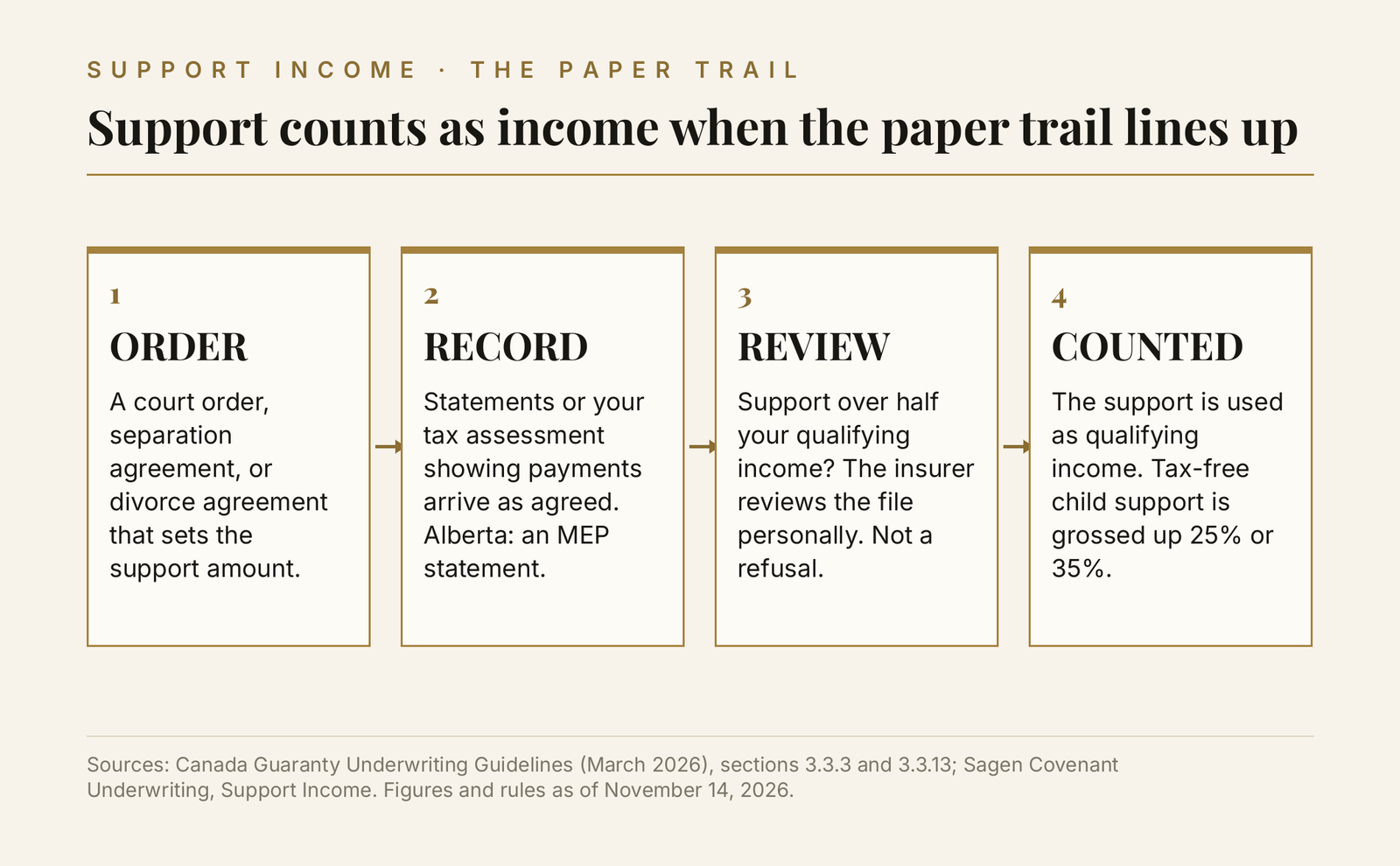
- The legal document. A court order, separation agreement, or divorce agreement that sets out the support amount. One of these is required. An informal arrangement between you and your former partner, with no order or agreement behind it, has nothing for an underwriter to rely on.
- Proof the money arrives. Your most recent Notice of Assessment, or recent bank statements confirming the payments are received as agreed.
Neither insurer fixes an exact number of months of statements in its published guidelines. The standard is that the payment history matches the amount you are asking the lender to count. A clean, consistent record is the whole game. Missed or irregular payments are the most common reason support income gets reduced or set aside.
In Alberta, if your support runs through the Maintenance Enforcement Program (MEP), you already have an official payment record. MEP’s Statement of Account shows month by month whether support was paid, and you can request it through MEP Accounts Online. It is one of the tidiest ways to show a receipt history. The same idea applies on a leave file, where the employer’s return to work letter is the document that lets a lender qualify you on your returning salary.
The three year rule is a myth, and here is where it actually lives
You may have read that child support only counts if it will continue for at least three more years. That rule is real, but it does not live where most articles put it.
- In the United States, Fannie Mae applies a three year continuance test to support income. It is not in Canada Guaranty or Sagen’s published support rules, which ask only that the support be expected to continue under the order or agreement.
- In Canada, the three year test does exist, but it attaches to the Canada Child Benefit. Both insurers require the CCB amount used to be sustainable for a minimum of three years, and Sagen also caps CCB at 30 percent of total qualifying income.
Why this matters: a parent whose youngest child is two years from aging out of child support is not automatically disqualified by a three year rule that does not exist in the Canadian guidelines. The real question is what the order says and whether the payments are landing.
When support is most of your income
There is one threshold worth knowing. Under both Canada Guaranty and Sagen’s guidelines, if support represents more than 50 percent of the total income used to qualify, the application is referred to the insurer for a closer review. That is a referral trigger, not a cap and not a refusal. It means an underwriter looks at the full file personally, so the documentation has to be in order before the file goes in, not after.
The gross up: non-taxable support counts for more than its face value
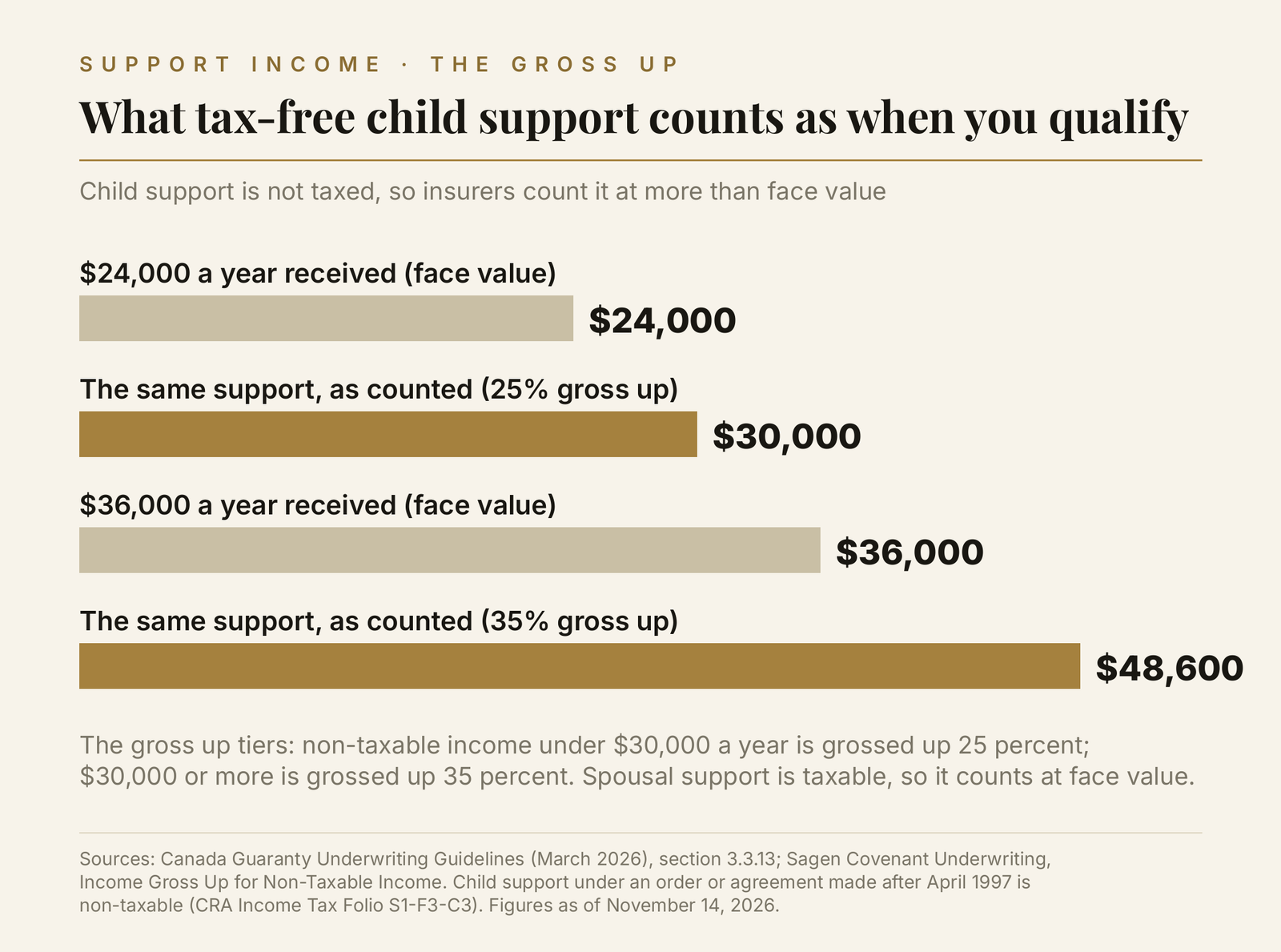
Because child support is not taxed, a dollar of child support is worth more than a dollar of employment income after tax. Both insurers recognize this. Under Canada Guaranty (section 3.3.13) and Sagen’s published gross up rules, non-taxable income can be grossed up for qualifying:
- Non-taxable income under $30,000 a year: gross up of 25 percent.
- Non-taxable income of $30,000 or more: gross up of 35 percent.
So $24,000 a year in child support can be treated as $30,000 of qualifying income. Spousal support does not get this treatment, because it is taxable.
If you are the one paying support
The mirror image applies. Child and spousal support you pay is based on your separation agreement and included in your total debt service ratio (Canada Guaranty, section 3.2.10; Sagen, Covenant Underwriting). For insured mortgages, total debts including support payments must fit within a 44 percent TDS limit. Support you pay does not reduce your income on paper; it competes with the mortgage payment inside your debt ratio, which is why the amount and the agreement wording matter on both sides of a separation.
A real file pattern: support as the only income
Here is a situation I see in my own practice, details changed: a borrower whose entire income is $10,000 a month in court-ordered spousal support, renewing an existing mortgage and adding a home equity line of credit. No employment income at all.
That file is workable, and it shows the rules above in action. The court order sets the amount, so the first document test is met. The support is 100 percent of qualifying income, well past the 50 percent mark, so the file goes to the insurer as a referral and the payment record has to be spotless. Because the support is spousal and taxable, there is no gross up. And because it is a renewal with a HELOC, the combined borrowing still has to respect the standard limits: a HELOC portion capped at 65 percent of the home’s value, and total mortgage plus HELOC borrowing capped at 80 percent.
Nothing about that file is exotic. It succeeds or fails on paperwork that either exists or does not.
Before you apply: the support income checklist
This list sits inside the wider document set in my mortgage application checklist. For a support income file, gather these first:
- Your court order, separation agreement, or divorce agreement, complete and signed.
- Bank statements showing the support deposits landing, matching the ordered amount.
- Your most recent Notice of Assessment.
- If you are in Alberta and enrolled, your MEP Statement of Account.
- If you pay support as well as receive it, the agreement pages that set out what you pay.
- A note of any end dates or review dates in the order, so there are no surprises mid-file.
Frequently asked questions
Can I qualify with only support income and no job?
Yes, it is possible. Both Canada Guaranty and Sagen allow support as qualifying income with the right documents. Because support over 50 percent of your total income triggers an insurer referral, the file needs complete documentation from the start.
Do I need a court order, or is a separation agreement enough?
Either works. Both insurers accept a court order, a separation agreement, or a divorce agreement as the primary document. What does not work is an informal arrangement with no signed document behind it.
My former partner pays late some months. Does that kill the file?
It weakens it. The guidelines ask for statements confirming payments are received as agreed. A pattern of late or missed payments can lead an underwriter to reduce the income used or decline to count it, which is one reason an MEP record or a clean stretch of on-time deposits helps.
Is child support treated differently from spousal support?
Not in the insurers’ support rules. The difference is tax: child support under a post-April 1997 order or agreement is tax free, so it can be grossed up by 25 or 35 percent. Spousal support is taxable, so it is used at face value.
If keeping the home is the goal, the buyout itself runs on its own rules. Whether you can afford to keep the house turns on the same four numbers — I run them, with a worked Calgary example, in my guide to keeping the house after separation.
Insurer guidelines and tax rules change, and every file is assessed on its own facts. If support is part of your income picture, confirm your own situation before you apply: book a call with Aky.
Sources: Canada Guaranty Underwriting Guidelines (March 2026), sections 3.2.10, 3.3.3, 3.3.13, 3.3.16; Sagen Covenant Underwriting, Support Income and Income Gross Up sections; Canada Revenue Agency, Income Tax Folio S1-F3-C3, Support Payments; Government of Alberta, Maintenance Enforcement Program information sheets.
This article provides general information. Mortgage options and eligibility depend on your circumstances and lender requirements. Speak with Aky about your situation.