By Aky Abrol, Mortgage Expert, Artisan Mortgages, Calgary
Yes, one spouse can keep the matrimonial home after a separation, and the mortgage rules have a specific route built for it. A buyout is not underwritten as a refinance. The mortgage insurers treat it as a purchase: the spouse who stays buys the departing spouse’s interest in the home. Under Sagen’s published guidelines, that purchase can go up to 95 percent of the home’s value, well past the 80 percent cap on a standard refinance, as long as both spouses are currently on title and a finalized separation agreement or court order is on file. Canada Guaranty covers the same kind of transaction in its underwriting guidelines, the purchase of a co-borrower’s interest.
Here is how a buyout is structured, what the insurers require, what the numbers look like on a real Calgary example, and the order the steps have to happen in.
Why a buyout is not a regular refinance
When most people hear “keep the house,” they picture a refinance: pay out the old mortgage, borrow enough extra to pay the departing spouse their share of the equity, and carry on. The problem is the ceiling. A standard refinance in Canada stops at 80 percent of the home’s value, and mortgage default insurance is not available to stretch a refinance past that line. On a home with a large mortgage still owing, the payout to the departing spouse often does not fit under 80 percent, and the refinance answer comes back no even when the spouse who stays can comfortably carry the payment.
The buyout route exists because the transaction is genuinely different. One owner is selling their interest to the other. Insurers underwrite it as that purchase, and purchases can be insured up to 95 percent loan-to-value. Two consequences follow:
- Above 80 percent, the new mortgage must be insured, and the insurance premium is added to the mortgage balance. That cost is real, and it is in the worked example below.
- If your numbers already fit at or under 80 percent, you do not need this route. An ordinary refinance does the same job with no premium. The buyout structure matters when the payout pushes you past 80 percent.
What the insurers require
Sagen’s Equity Buy-Out rules (Real Estate Underwriting) set out the clearest published version of the requirements:
- Both parties must be currently on title to the property. This is a buyout of an existing owner’s interest, not a new purchase from a stranger.
- Documentation on file that validates the purchase and its price. The lender must retain proof that the remaining borrower is buying the departing borrower’s interest, and the sale price of the transaction. Sagen accepts any one of: an agreement of purchase and sale, a finalized separation agreement, or a court order.
- A full interior appraisal, which Sagen completes, to set the value the loan is measured against.
Two things worth knowing about that list. First, the buyout amount itself comes from your separation agreement or court order. The lender does not set the price of your spouse’s share; the agreement does, and the financing is built around that number. Second, Sagen’s wording covers any borrowers on title, not only spouses. Spouses are the common case, and the rest of this article is written for them, but the same structure can apply to other co-owners.
Canada Guaranty addresses the same transaction in its underwriting guidelines as a purchase of a co-borrower’s interest, and each insurer and lender applies its own requirements on top. The practical shape, though, is consistent: agreement first, appraisal, and one borrower qualifying alone.
The worked example: a $650,000 Calgary home
Here is a situation I see in my own practice, details changed into a composite. A Calgary home appraised at $650,000, owned 50/50, with $410,000 still owing on the mortgage. One spouse wants to stay.
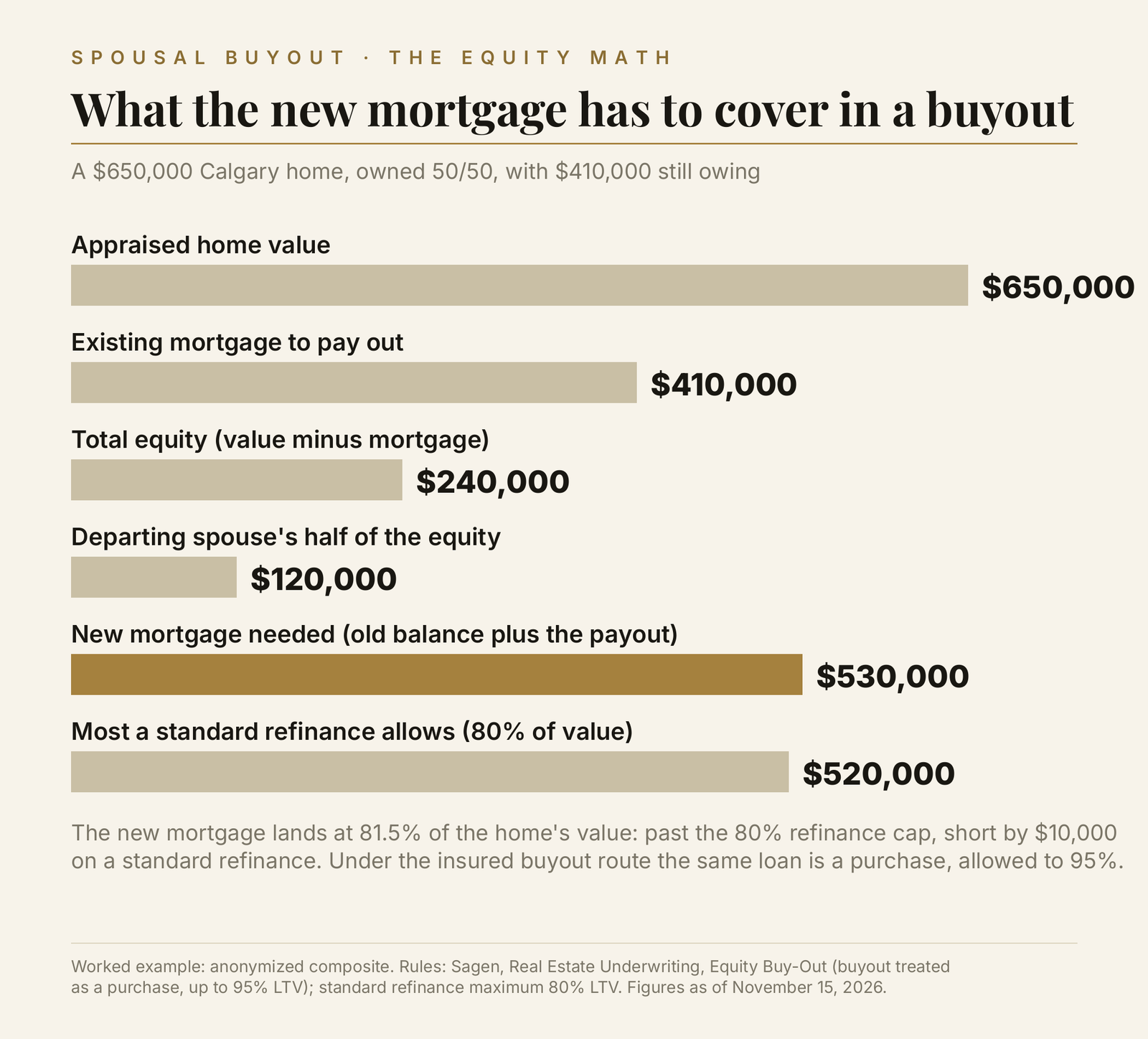
- The equity is $650,000 minus $410,000, which is $240,000.
- Each spouse’s half of the equity is $120,000. That is the buyout amount the agreement would carry.
- The new mortgage has to do two jobs: pay out the existing $410,000 mortgage and pay the departing spouse $120,000. Total needed: $530,000.
- $530,000 against a $650,000 value is 81.5 percent loan-to-value. A standard refinance caps at $520,000, which is $10,000 short. That small gap is the entire reason the buyout route exists.
- Because the loan is over 80 percent, it is insured. Under Canada Guaranty’s published premium table, the standard premium in the 80.01 to 85 percent band is 2.80 percent of the loan: $14,840 on $530,000. The premium is added to the mortgage, bringing the total to $544,840, or about 83.8 percent of the home’s value. Alberta has no provincial sales tax, so no provincial tax is added to the premium here.
Notice what the ceiling is not doing in this example. At 95 percent, the spouse could theoretically borrow up to $617,500. The limit is rarely the binding constraint. The binding constraint is the next section: one income has to carry the new mortgage.
Qualifying on one income
The spouse who stays must qualify for the new mortgage on their own income, under the insured limits. Canada Guaranty’s published maximums for insured mortgages are a gross debt service ratio of 39 percent and a total debt service ratio of 44 percent, and the federal stress test applies to the new mortgage just as it does to any new borrowing.
Everything in your separation agreement touches this calculation:
- Support you receive can count toward your qualifying income, with the right documents behind it. I covered those rules in detail in my guide to using spousal or child support as income for a mortgage.
- Support you pay is counted inside your total debt service ratio, which reduces the mortgage you can carry.
- Debts that stay in your name after the separation count too, whether or not the agreement assigns them to your former spouse. The lender follows whose name is on the debt, not the agreement’s intentions.
One more point both spouses should understand. Until the new mortgage funds and the title transfers, both borrowers remain fully responsible for the existing mortgage. A separation agreement is a contract between the two of you; it does not change the contract either of you signed with the lender. The departing spouse’s release happens at funding, not at signing, which is why the financing timeline matters to the person leaving as much as to the person staying.
The steps, in order
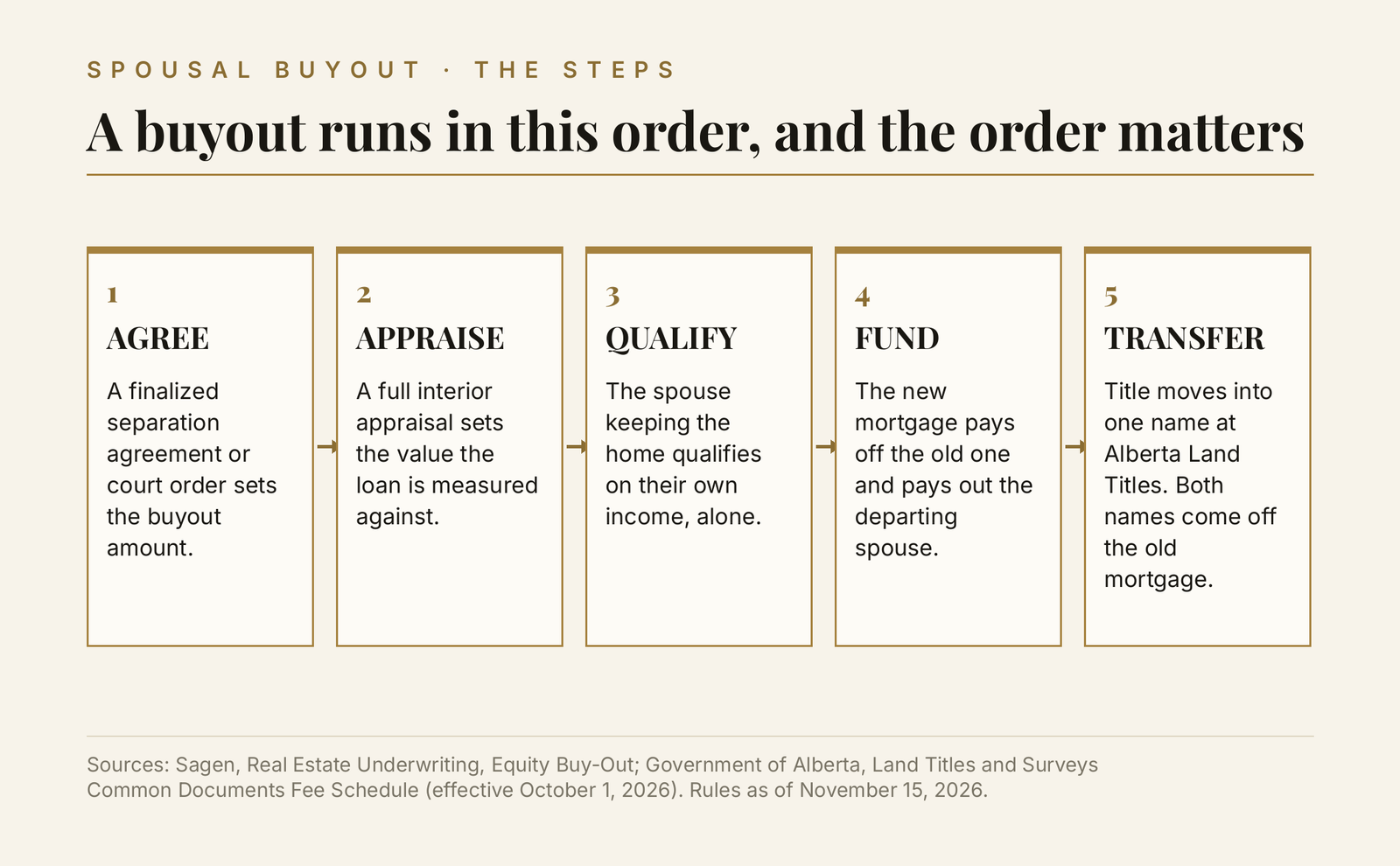
- Agreement. A finalized separation agreement or court order sets the buyout amount. This document is what the lender works from.
- Appraisal. A full interior appraisal sets the home’s value, which the loan-to-value is measured against.
- Qualify. The spouse keeping the home is underwritten alone, at the new mortgage amount.
- Funding. The new mortgage pays out the existing mortgage in full and pays the departing spouse their share. The departing spouse comes off the mortgage here.
- Title transfer. Your lawyer registers the transfer so the title sits in one name, along with the new mortgage.
The Alberta paperwork, and what it costs
Alberta has no land transfer tax. What you pay at Alberta Land Titles are registration fees, and they are modest. Under the Government of Alberta’s fee schedule (effective October 1, 2026), registering a transfer of land costs $50 plus $5 for every $5,000 of the land’s value, and registering a mortgage costs $50 plus $5 for every $5,000 of the mortgage principal.
On the worked example above, that is:
- Transfer of land on $650,000: $50 plus 130 × $5, which is $700.
- Mortgage registration on $544,840: $50 plus 109 × $5, which is $595.
- Total Land Titles fees: $1,295, plus your lawyer’s fees for the transfer and the new mortgage.
One Alberta-specific wrinkle your lawyer will check early. If the home is registered in only one spouse’s name, the other spouse holds dower rights in the homestead, and under the Dower Act a disposition of the homestead needs that spouse’s written consent, or a court order dispensing with it. Where both names are already on title, both spouses simply sign the transfer. Either way, it is a document to sort out at the start, not on closing day.
Before the agreement is final: check the math first
The most common buyout problem I see is sequencing. The separation agreement fixes the buyout amount, and couples understandably want the agreement finished. But if the amount in the agreement needs a mortgage that one income cannot carry, the file cannot fund as written, and everyone is back at the table after signing instead of before.
The fix costs nothing: run the qualification check while the agreement is still being negotiated. With the appraised value, the current mortgage balance, and one income, the affordable buyout range is a short calculation. The agreement can then carry a number that actually funds. I walk through that check, with a worked Calgary example, in my guide to the affordability check.
Two more checks belong in that same early conversation:
- The prepayment penalty. Paying out the existing mortgage mid-term can trigger a penalty, and it lands on top of the buyout math. If your renewal date is close, timing the buyout to renewal can avoid it. My guide to comparing the purpose and costs of a refinance walks through how those costs stack up.
- The legal side beyond the mortgage. Parenting, support, and property division each have their own rules and their own professionals. Justice Canada’s family justice services information lists free information and education services for separating families, including Alberta’s Resolution Support Centres in Calgary and Edmonton.
Before you apply: the buyout checklist
This list sits inside the wider document set in my mortgage application checklist. For a buyout file, gather these first:
- Your finalized separation agreement or court order, complete and signed, with the buyout amount stated.
- Your most recent mortgage statement, showing the current balance.
- Income documents for the spouse who is staying: employment letter, pay stub, and most recent Notice of Assessment.
- If support is part of the picture, the order or agreement pages that set out what is received and what is paid.
- A list of the debts that will remain in your name after the separation.
- Government identification for the borrower who is staying, and the current title details if you have them.
Frequently asked questions
Is the 95 percent measured against the home’s value, or against the equity?
Against the home’s value. The new mortgage must cover the existing mortgage balance plus the payout of your spouse’s share, and that total is measured against the appraised value. In the worked example, the equity was $240,000, but the new mortgage needed was $530,000, which is 81.5 percent of the $650,000 value.
Does the separation agreement have to be finalized before anything can start?
The affordability check can, and should, start any time. But for the insured buyout itself, the lender needs one of Sagen’s accepted documents on file: an agreement of purchase and sale, a finalized separation agreement, or a court order. A draft agreement is enough to run the numbers; it is not enough to fund the mortgage.
What if my spouse is not on title?
Sagen’s buyout rules require both parties to be currently on title, because the transaction is the purchase of an existing owner’s interest. If the departing spouse was never on title, this route does not apply, and the conversation becomes a standard refinance in the owner’s name, capped at 80 percent, with the Alberta dower consent handled as part of the paperwork.
What if I cannot qualify on my own income?
Then the buyout as written does not fund, and it is better to learn that before the agreement is signed. The paths people take from there include adjusting the buyout structure inside the agreement, reducing other debts first, adding a co-signer or guarantor where a lender allows one, or selling the home and dividing the proceeds. Which of those fits depends on the numbers, and the numbers are a short conversation.
Is the 95 percent measured against the home’s value, or against the equity?
Against the home’s value. The new mortgage must cover the existing mortgage balance plus the payout of your spouse’s share, and that total is measured against the appraised value. In the worked example, the equity was $240,000, but the new mortgage needed was $530,000, which is 81.5 percent of the $650,000 value.
Does the separation agreement have to be finalized before anything can start?
The affordability check can, and should, start any time. But for the insured buyout itself, the lender needs one of Sagen’s accepted documents on file: an agreement of purchase and sale, a finalized separation agreement, or a court order. A draft agreement is enough to run the numbers; it is not enough to fund the mortgage.
What if my spouse is not on title?
Sagen’s buyout rules require both parties to be currently on title, because the transaction is the purchase of an existing owner’s interest. If the departing spouse was never on title, this route does not apply, and the conversation becomes a standard refinance in the owner’s name, capped at 80 percent, with the Alberta dower consent handled as part of the paperwork.
What if I cannot qualify on my own income?
Then the buyout as written does not fund, and it is better to learn that before the agreement is signed. The paths people take from there include adjusting the buyout structure inside the agreement, reducing other debts first, adding a co-signer or guarantor where a lender allows one, or selling the home and dividing the proceeds. Which of those fits depends on the numbers, and the numbers are a short conversation.
Insurer guidelines, government fee schedules, and tax rules change, and every file is assessed on its own facts. If a buyout is part of your separation, confirm your own situation before you sign: book a call with Aky.
Sources: Sagen, Real Estate Underwriting, Equity Buy-Out (read November 15, 2026); Canada Guaranty, Products at a Glance and Premium Rates at a Glance (March 2026 set), and Underwriting Guidelines (March 2026), section 4.6; Government of Alberta, Land Titles and Surveys Common Documents Fee Schedule (effective October 1, 2026); Dower Act, RSA 2000, c D-15, sections 2 and 10; Justice Canada, Family Justice Services information.
This article provides general information. Mortgage options and eligibility depend on your circumstances and lender requirements. Speak with Aky about your situation.